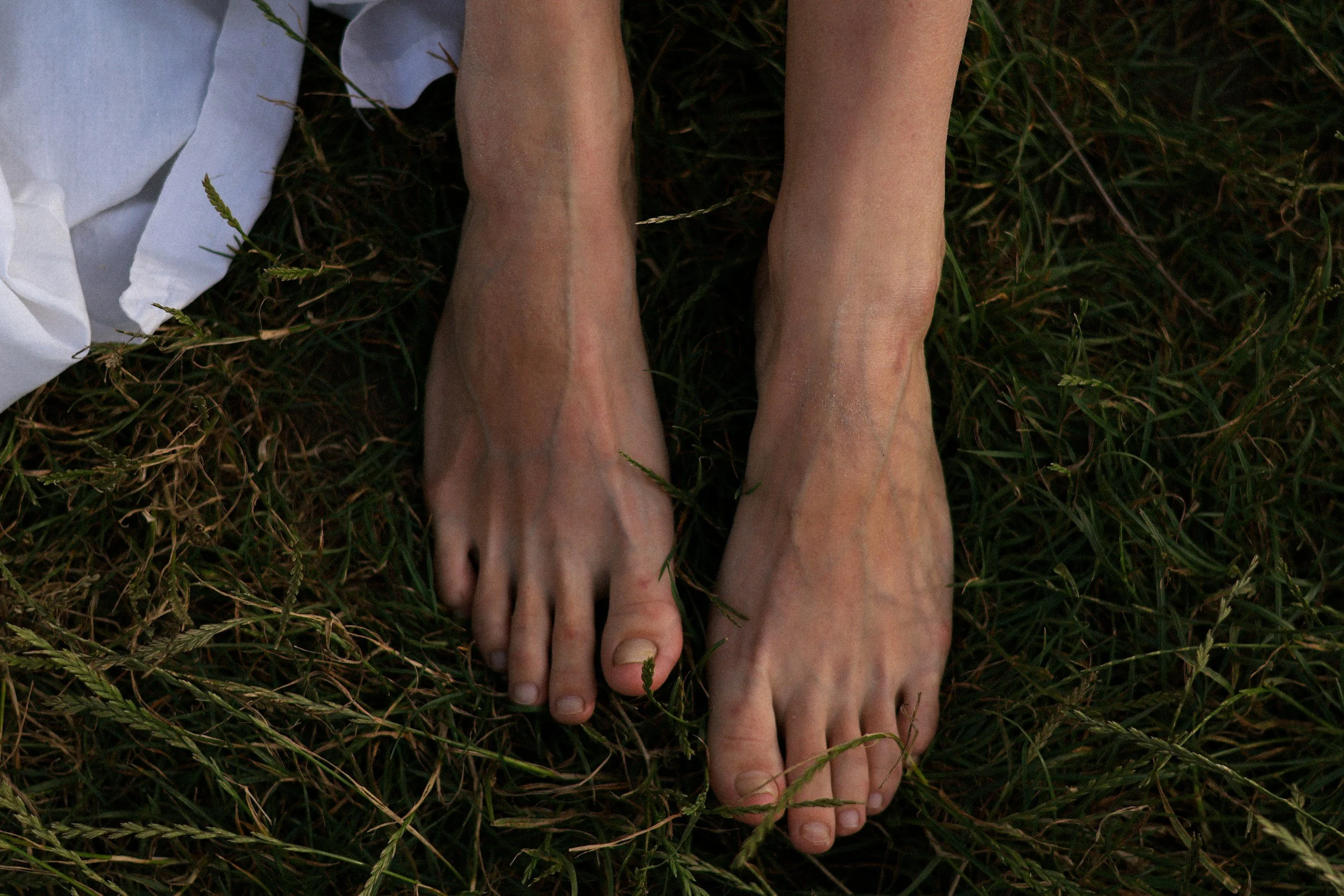
Go ahead, go barefoot!
What if the best thing you could do for your balance, strength, and stress was to simply… take your shoes off?
Lisa KielyApril 22, 2026
"Strength doesn't start at the gym.
It starts on the ground — literally."
Take off your shoes. Feel the floor under your feet. Notice how different that feels — the texture, the temperature, the way your toes spread out and your arch settles.
That sensation? Your body was designed for it. And most of us have been denying ourselves that experience for decades.
As someone who talks a lot about building a body that feels good to live in, not just one that looks good on a program — I've become genuinely fascinated by the research on barefoot exercise. What the science shows is quietly remarkable, especially for those of us over 40 who care about balance, stability, and doing less damage over time.
Your Feet Are Doing Way Less Work Than They Should Be
Each foot contains 26 bones, 33 joints, and over 100 muscles, ligaments, and tendons. Now that is structural complexity — and modern shoes, with their thick soles, raised heels, and narrow toe boxes, quietly switch most of it off.
A 2024 review published in PubMed Central found that barefoot and minimalist strength training produced meaningful improvements in intrinsic foot muscle volume, medial arch function, toe flexor strength, and neuromuscular control. What this means is that our feet get stronger when we use them the way they were designed to be used.
If you know me personally, you might remember that I had bunion surgery scheduled, and designed my own 6 week program to balance the muscles in my foot and after only 3 weeks I was pain free! You can bet I cancelled that surgery and I haven’t looked back.
Has my foot returned to normal? No, but it is pain free, and it works!
Six Reasons to Ditch the Shoes (Even Just for Your Workout)
Another study comparing experienced barefoot runners with high-tech shoe runners found that barefoot runners showed significantly greater thickness in multiple intrinsic foot muscles and notably more ankle dorsiflexion range of motion — meaning more mobility and more strength, just from going without shoes. I’m not recommending you start running bare foot, but I do think you should try walking barefoot!
1) STRONGER FEET & ANKLES
Barefoot training reactivates the small intrinsic muscles shoes suppress, building a resilient foundation for every movement you make.
2) BETTER BALANCE
Direct ground contact sends continuous sensory feedback to your brain, training your neuromuscular system to stay steadier and react faster.
3) IMPROVED PROPRIOCEPTION
Your body's sense of its position in space declines with age. Barefoot exercise is one of the most effective ways to keep that sensory pathway sharp.
4) SHARPER MIND
A 2024 study found 12 weeks of barefoot walking produced measurable increases in alpha waves, cognitive speed, and concentration — vs. sneaker walkers.
5) REDUCED INFLAMMATION
Direct skin contact with the Earth — known as grounding or earthing — has been linked in multiple studies to measurable reductions in inflammatory markers.
6) TRESS RELIEF & SLEEP
Barefoot walking outdoors activates the parasympathetic nervous system, potentially lowering cortisol and supporting deeper, more restorative sleep.
WHAT THE RESEARCH SAYS ABOUT BALANCE AND FALLS
For those of us prioritizing our functional independence, this one matters most. Research published in BMC Geriatrics found that barefoot walking is more stable for gait and balance recovery in older adults. A 16-week randomized trial studying barefoot cobblestone mat walking found significant improvements in balance, chair-stand performance, walking speed, and even blood pressure compared to a regular walking group.
Worth knowing: A 2021 randomized controlled trial found that participants who wore minimalist shoes for at least 70% of their daily shoe time over six months experienced a 57% increase in foot strength. You don't have to go fully barefoot to benefit — less shoe is more.
Grounding: The Part That Surprised Me Most
OK…when I first heard about "earthing," I rolled my eyes a little. Walking barefoot on grass to absorb electrons from the Earth? It sounded more “woo woo” than science.
But …research published in the Journal of Inflammation Research found that grounding produces measurable differences in white blood cells, cytokines, and other molecules involved in the inflammatory response. A 2023 Korean study on barefoot walkers in an urban forest found real improvements in serotonin levels and immune markers compared to sneaker-wearing walkers.
Chevalier et al. documented normalization of cortisol rhythms, reduced blood viscosity, and improved heart rate variability in grounded individuals. These are not subjective impressions — they are measurable physiological shifts.
Is the research definitive? Not yet. WebMD and the Cleveland Clinic both acknowledge the promise while calling for larger studies. But the risk of trying it is essentially zero, the cost is zero, and the reported benefits — reduced inflammation, better sleep, lower stress — are exactly what most of us are working hard to achieve anyway.
TRY THIS TODAY
20–30 minutes barefoot on grass, sand, or soil.
No gear. No gym. No cost. Your feet will thank you.
How to Start (Without Hurting Yourself)
The one thing I want to be clear about transitioning to barefoot exercise should be gradual. Your feet have likely spent years in supportive shoes, and the muscles that barefoot movement relies on need time to wake up and build capacity.
Start inside. Do your squats, your balance work, your stretching in bare feet, with or without me, at home. Notice how much more your legs and core activate when you remove the cushion and your feet have to do real work. Then take it outside — soft surfaces like grass or sand are ideal for beginners. Walk slowly. Pay attention to how your foot lands. That awareness alone is a workout.
A note of care: if you have diabetes, peripheral neuropathy, severe flat feet, or a recent foot injury, check with your doctor or physical therapist before going fully barefoot. For many older adults, minimalist footwear — wide toe box, zero heel drop, thin flexible sole — offers the same muscular and proprioceptive benefits while keeping your feet protected. It is not all or nothing.
My Take
This is exactly the kind of small, sustainable, zero-cost shift I love talking about — the kind that quietly compounds into something meaningful. Better balance. Stronger feet. A calmer nervous system. More sensory connection to your own body and the world around it.
We spend so much time looking for the next program, the next supplement, the next upgrade. Sometimes the upgrade is removing something. In this case: your shoes.
Step outside today. Feel the ground. Your body has been waiting for this.
My best, Lisa
REFERENCES
Gómez-Carrión et al. (2025). Effects of Barefoot and Minimalist Footwear Strength-Oriented Training on Foot Structure and Function in Athletic Populations: A Systematic Review. PMC.pmc.ncbi.nlm.nih.gov
Park et al. (2024). Barefoot walking improves cognitive ability in adolescents. Korean Journal of Physiology & Pharmacology.pmc.ncbi.nlm.nih.gov
Lee et al. (2024). Effects of Barefoot Walking in Urban Forests on CRP, IFNγ, and Serotonin Levels. PMC.pmc.ncbi.nlm.nih.gov
Lara-Palomo et al. (2024). Effects of technological running shoes versus barefoot running on intrinsic foot muscles, ankle mobility, and dynamic control. Journal of Body Work & Movement Therapies.pmc.ncbi.nlm.nih.gov
Curtis R. et al. (2021). Daily activity in minimal footwear increases foot strength. Scientific Reports.
Oschman JL, Chevalier G, Brown R. (2015). The effects of grounding (earthing) on inflammation, the immune response, wound healing, and prevention and treatment of chronic inflammatory and autoimmune diseases. Journal of Inflammation Research.
Chevalier G. et al. (2012). Earthing: Health Implications of Reconnecting the Human Body to the Earth's Surface Electrons. Journal of Environmental and Public Health.
Ren X. et al. (2022). Barefoot walking is more stable in the gait of balance recovery in older adults. BMC Geriatrics, 22:904.
Li M. et al. 16-week randomized trial: Cobblestone mat walking vs. regular walking in older adults. Referenced in: PMC10105031
Hollander K. et al. (2017). Long-Term Effects of Habitual Barefoot Running and Walking: A Systematic Review. Medicine & Science in Sports & Exercise, 49(4), 752–762.
GoodRx Health (2024). 4 Benefits of Walking Barefoot and Risks to Consider. goodrx.com
Lisa Kiely
www.LisaKiely.com
64 years strong | Traveling Light | Moving More
Please send your questions/comments or reach me by clicking here
Join Lisa Kiely fitness classes and on demand video membership here: