The Cat Who Disappeared
HOUSE & PET SITTING • THE SITTING LIFE
Six days, one hundred flyers, and everything I now understand about the difference between fault and responsibility.
BY LISA KIELY
I have been house and pet sitting for ten years. Elderly dogs on complicated medication schedules. Parrots. Tortoises. Homes with full-time staff and homes with nothing but a key under a pot. I take this work seriously—I always have.
And on the first morning of an eleven-day sit, I could not find the cat.
The first night
EVERYTHING ABOUT IT WAS NORMAL.
I arrived carefully. I have to say that, because I have replayed it in my head roughly nine hundred times since.
I was deliberate coming in and out with my bags. I watched the doors. I knew there was a cat, I knew she was an indoor cat, and I was paying attention.
She was shocked when I first came in. She didn't run and vanish—she moved to the far side of the room and sat down and watched me. I tried to play with her. She wasn't interested. She stayed exactly where she was, keeping her eyes on me, deciding.
That is normal. A one-person cat who has been with her mom and almost nobody else for more than a year is going to sit across the room and study the stranger who just walked in with luggage. That's not a warning sign. That's a cat.
I took a photo of her, texted it to her mom, told her we were settled in.
Then I went to bed. In the morning she was gone.
The house is enormous
WHICH MADE THE FIRST DAY SURVIVABLE, AND THEN UNBEARABLE.
The house is huge. Multiple levels, indoor and outdoor spaces braided together, terraces, rooms I hadn't opened yet. So my first thought was the reasonable one: she's hiding. Of course she's hiding. Her person left, a stranger moved in, and cats do this. She's under something. She'll come out when she's hungry.
I looked everywhere. Then I looked everywhere again, slower. Then I started looking in places that didn't make sense—which is how you know the story in your head has already changed.
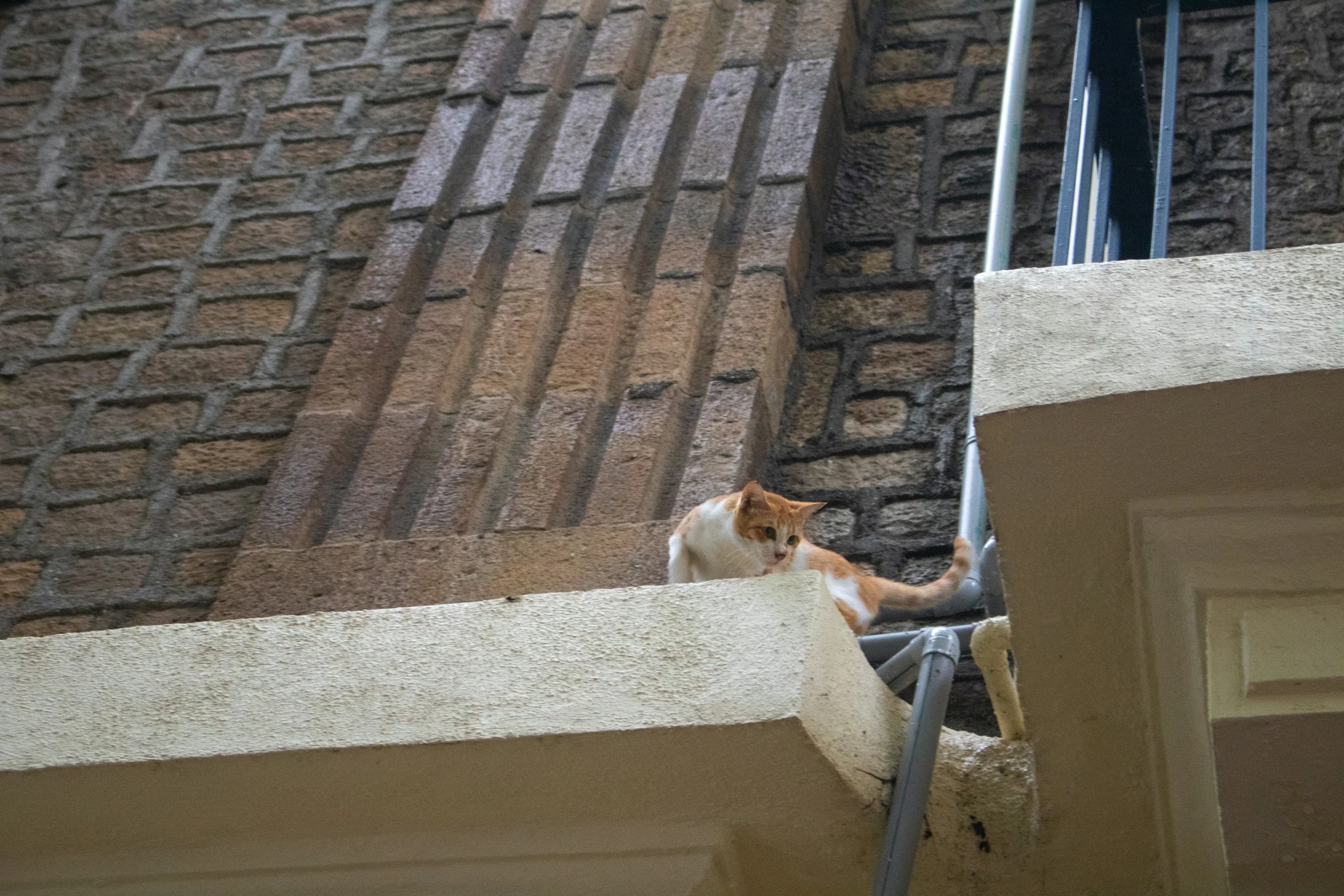
By the end of that first day I had to face the other possibility. She could have gone out. And if she'd gotten onto the second or third level outdoor space, she could have jumped to the neighbors'.
I learned it had happened before. She had jumped off a terrace wall down into the neighbors.
We asked them. I am not sure now now which day it was—the days ran together in a way I've never quite experienced—but we went, and I wea sked, and they told us she wasn't there.
We went. We asked. We were told no. She was found on that property days later.
I'm not writing that to blame anyone. People look. They don't see her. They answer honestly, because as far as they know, it's true. A cat who does not want to be found is extraordinarily good at not being found—and a "no" given in complete good faith still closes a door.
But I have thought about that answer every day since.
I called her mom that first morning
AND THEN I CONTINUED CALLING (OR TEXTING).
I didn't wait to see whether the cat would turn up. I called her that morning, and I stayed in close contact with her the entire time—every day, often several times a day.
Every suggestion she made, I acted on immediately. Not eventually. Immediately. She knows this cat. I don't. My job was not to have better ideas than the woman who raised her; my job was to be her hands and her feet in a house she couldn't get to.
What the search actually looked like
NOT A SIGN ON A POLE. SOMETHING CLOSER TO A MISSION.
I walked the neighborhood two and three times a day. Every day.
THREE THINGS I CARRIED, EVERY WALK
1) Her mom's voiceA recording of her owner calling her name. The single best tool I had out there.
2) A container of treatsShaken the whole way, block after block, so the sound went where my voice couldn't.
3) The cat carrier. Because I did not want to be the person who finally found her and had nothing to put her in.
I stopped everyone I passed. I showed her picture. I explained what happened, over and over, to strangers—in the particular tone of someone trying very hard not to cry in front of strangers.
Her mom's friend came over and searched the house with me from top to bottom, a second set of eyes on every closet and crawlspace. Then she made flyers. Between us we put one hundred flyers into the houses surrounding that one.
There are open fields nearby. This cat had walked them before, on a leash. So she'd had a taste of outside—enough to be curious, nowhere near enough to survive out there.
The false alarms
HOPE ARRIVES FAST AND LEAVES FASTER.
One morning a neighbor reported hearing a cat crying. My whole body went up like a flare. We went and looked.
The neighbors had houseguests. The houseguests had a cat.
That one changed how I worked. Until that morning, information had been reaching me by accident—a person on the street, a knock on a door, whoever happened to think of me. So I started a WhatsApp group with her mom's friends and the neighbors, and from then on we were all watching at once and everything landed in one place.
Later, a woman told me she had video of a cat that had turned up on her property—the day after I arrived. The timing was perfect. I have rarely wanted anything so badly in my life.
It wasn't her.
The part nobody warns you about
THE WEIGHT YOU ACCEPT ALONG WITH THE KEYS.
I didn't sleep. Not "slept poorly." Didn't sleep.
I replayed every movement of my arrival like security footage. Unloading the car. Which door. How long it stood open. Did I turn my back. Was there one second when—
I ran that loop constantly, in the dark, for days.
I cancelled everything outside the house for the first several days. When I finally did start going out again, I kept it close to home and I kept it short—an hour, maybe, never far.
I told my clients that our meetings might get interrupted, and then they were. I took her mom's calls in the middle of business meetings and I did not apologize for it. There was a cat missing.
Eventually my body did what bodies do when you refuse to let them rest. I got sick.
I know it wasn't my fault. It was still my responsibility. Both of those things are true, and the work is learning to hold them at the same time.
She's a one-person cat. This was traumatic for her. It was traumatic for me.
The call
OF ALL THE MOMENTS.
Sunday I felt well enough to do something normal. Friends were taking an afternoon trip nearby and I said yes.
I was on the bus when the call came. She was at the neighbors'.
Six days. One day short of a week.
I had walked those streets two and three times a day with a carrier in my hand—and when she finally surfaced, I was on a bus, unable to turn around and go get her.
I'll be honest. That was hard. Not the worst part of the week, but a sharp, specific frustration I hadn't braced for.
So I did the only thing available to me. I made calls. Her mom's friend—who by then had become a friend and partner in all of this—found someone who could reach the cat, pick her up, and take her straight to the vet. I stayed in contact (except in the no cell service zone -which was maddening).
The vet kept her overnight. IV fluids.
She is staying a second night. She's still dehydrated. She's wobbly on her feet. She hasn't eaten. She is in very good hands, and I am reminding myself of that on a loop.
When she does come home, I will keep her in one room. One safe, quiet, contained room with everything she needs, until her mom is home. It's already set up. It has been for two days.
Her mom has been distraught—and has been carrying several other hard things at the same time. That's the piece I keep sitting with. The person you're sitting for isn't off on a carefree vacation. They're living their life somewhere else, and this landed on top of everything already in their arms.
What I know now
SOME OF THIS I'D CHANGE. SOME OF IT I'D DO EXACTLY THE SAME.
A neighbor's "no" is not a search.
This is the one I'd change. I asked the right question at the right house—and then I accepted the answer. Next time I'll ask something different: may I come look myself? Under the deck, behind the shed, in the garage, up on the roofline. Not because anyone is lying. Because a frightened cat is very small and very still, and the person answering the door has no reason to know where she'd hide.
A new-to-you cat starts in one small, contained room.
Not because she's fragile. Because you are new. The first forty-eight hours are the highest-risk window there is: unfamiliar person, unfamiliar smell, doors opening for luggage. A one-person cat especially deserves one safe room until she's decided you're acceptable. That's how she'll come home today, and that's how the next one will start.
Watch the animal, not the checklist.
She sat across the room and watched me and wouldn't play. That was normal—and it was also information. She hadn't accepted me yet. Nothing about that required alarm, but it did deserve a plan, and the plan is the contained room.
Constant contact with the owner is the job.
This one I'd repeat exactly. Reach them early, stay in touch daily, and act on every suggestion immediately—no filtering, no waiting to see. They know the animal. You're the hands and feet. Agree in advance on how they want to be told and how often, while everyone is still calm.
Build the network before you think you need it.
I started the WhatsApp group early, after the first lead, and I'd do it earlier in the future. Flyers, neighbors, the friend who searched the house with me—a search runs on people, and people take time to gather. Gather them first.
Tell your clients the truth.
I said my meetings might get interrupted. Then I took the calls. Nobody minded, and pretending otherwise would have cost me focus I didn't have to spare. Say what's happening. People are generally kinder than we expect.
Fault and responsibility are different things.
I did not cause this. I also could not put it down. If you sit for people, you will eventually meet the gap between those two facts, and the gap is where the guilt lives. Knowing it isn't your fault does not release you from the work—and doing the work does not require you to accept blame you don't deserve.
Ask Before Every Sit
Print this. Bring it to the meet-and-greet or the Zoom. Ten minutes of questions now is worth six days of walking later.
HOW THIS ANIMAL OPERATES
Has she ever gotten out? How, where, and who found her?
Favorite hiding places, inside and out
Is she a one-person animal, or comfortable with new people?
Which doors, windows, terraces or rooflines are the actual risk points?
Has she ever been outside on a leash, and where?
Does she come when called—and to whose voice?
BEFORE THE OWNER LEAVES
Voice recording of the owner calling her name
Three to five recent, clear photos, including distinctive markings
Microchip number and confirmation the registration is current
Collar and tag on, if she wears one
Vet name, address, hours, emergency line, and card on file
Written permission to authorize treatment, with a spending limit
Introductions to the neighbors on every adjoining property—by name, in person if possible
Standing permission to search those properties myself if she goes missing
Group chat with the owner's local friends and neighbors, set up on day one
THE FIRST FORTY-EIGHT HOURS
One small, contained room set up before I arrive—litter, water, food, bed, hiding spot
All luggage in before the cat is released from that room
Every exterior door, gate, and terrace walked and checked personally
Eyes on the animal at least twice a day, confirmed—not assumed
Photo and note to the owner the first night
IF SHE DISAPPEARS
Search the house completely, twice, including the impossible places
Notify the owner right away, and keep contact daily from there
Go to every adjoining property and walk it yourself—don't stop at the doorway
Walk with the voice recording, treats, and a carrier
Start the group chat immediately, before there's anything to report
Flyers to every surrounding house
Local vets, shelters, and community pages notified
Keep a written log of where and when you searched
Expect false alarms, and check every one of them anyway
What I keep coming back to
I want to be careful about what I claim to have learned here, because the tidy version of this story isn't true. The tidy version is that I missed something and now I know better.
I didn't miss it. I knew it had happened before. I called her mom the first morning. I went and asked the neighbors. I did everything she suggested the moment she suggested it, I built the group, I made the flyers, I walked those streets until I made myself sick.
And she was gone for six days anyway.
So the lesson isn't that good questions prevent bad outcomes. It's that when you take someone's keys, you take on something you can't fully control—and what you owe them is not a guarantee. It's everything you've got, every day, until it's resolved.
It isn't resolved yet. She's spending a second night at the vet, the room is waiting for her, and I'll be here when she comes through the door.
Lisa Kiely is a certified personal trainer, gerontologist, and experienced house and pet sitter. She has been sitting in the USA and Mexico for ten years and keeps her own home in San Miguel de Allende.
If you're planning travel and want your home and your animals in careful, communicative hands—let's start with a conversation.
More sitting stories at lisakiely.com/blog